
The Decision Problem
Large, regulated enterprises were under pressure to “do something with AI,” yet leadership faced a high-risk dilemma:
- How do we introduce AI agents into critical workflows without undermining trust, compliance, or operational stability?
- How do we avoid disconnected pilots that don’t scale?
- How do we ensure AI supports human decision-making instead of replacing it blindly?
This was not a tooling problem.
It was a strategy and operating model problem.
Leadership needed clarity on where AI should act, where humans must stay in control, and how agents should be governed across the organization—before committing to platforms or implementations.
The Risk
Without a clear orchestration strategy, the risks were significant:
- AI agents operating without consistent guardrails
- Inconsistent decision quality across teams and workflows
- Compliance and explainability concerns in a regulated environment
- Loss of trust from both employees and leadership
The greatest risk wasn’t AI failure.
It was premature adoption without a system for accountability and scale.
The Insight
AI agents are most effective when treated as participants in a system, not standalone tools.
Through discovery and leadership alignment, it became clear that:
- Different agents require distinct roles (analysis, triage, synthesis, recommendation, validation)
- Not all decisions should be automated
- Human-in-the-loop design is essential for trust, escalation, and learning
- AI must be introduced as part of an operating model, not a feature set
CX and UX thinking were critical—not to design interfaces, but to design how humans and agents interact within workflows.
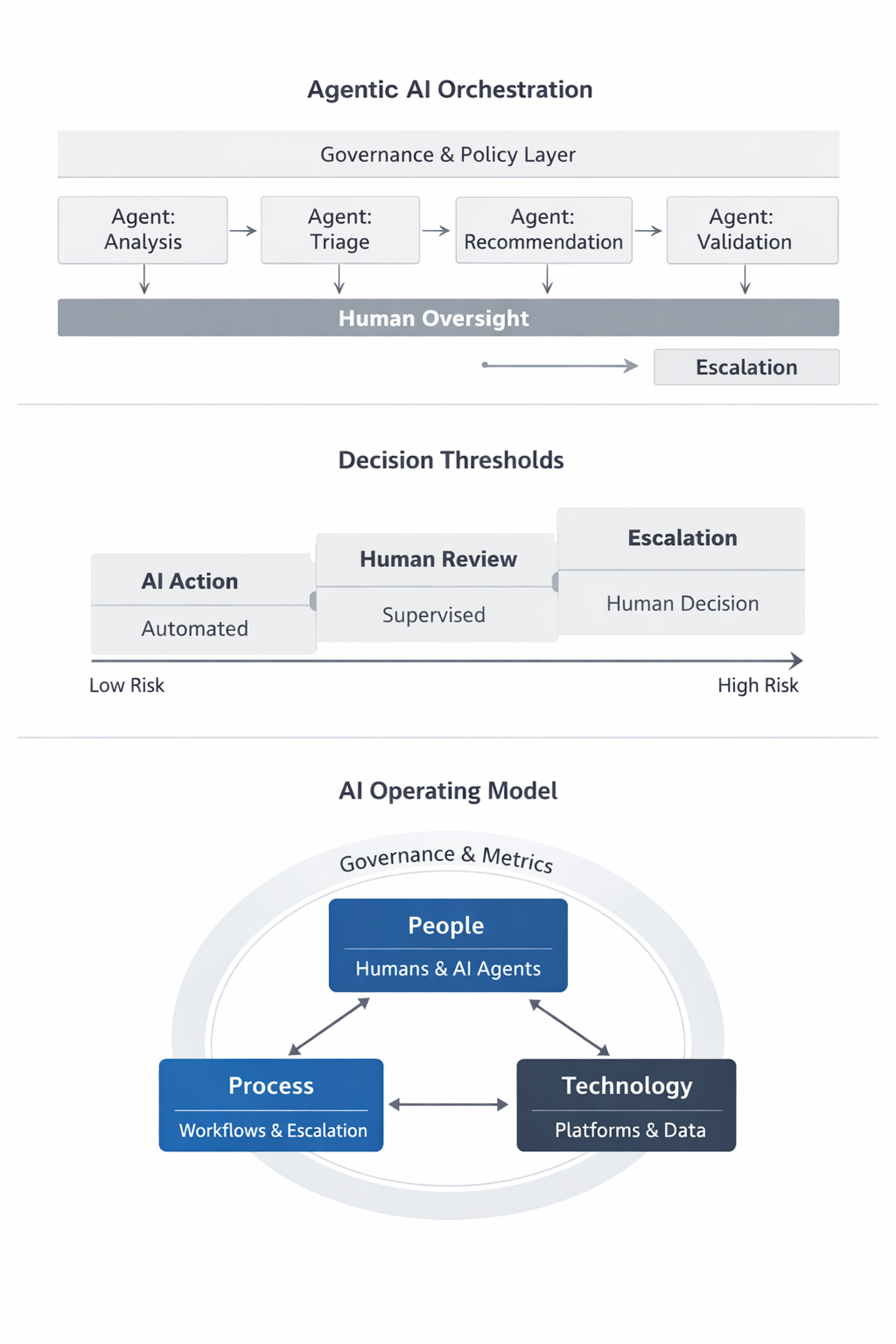
The Strategy: Agentic AI Orchestration
I led the definition of an agentic AI orchestration strategy focused on responsible adoption, clarity of roles, and operational safety.
The strategy centered on four principles:
1. Agent Role Definition
Each AI agent was assigned a clear purpose—such as analysis, routing, summarization, or recommendation—preventing overlap and unintended autonomy.
2. Human-in-the-Loop Guardrails
Decision thresholds were explicitly defined:
- When agents could act independently
- When human review was required
- When escalation was mandatory
This preserved accountability and trust.
3. Workflow-Centered Design
Rather than inserting AI into isolated tasks, agents were designed to support end-to-end workflows, improving consistency and decision quality across teams.
4. Governance by Design
Explainability, auditability, and compliance were embedded into the orchestration model from the start, rather than retrofitted later.
This approach reframed AI from “experimental technology” to a managed participant in enterprise operations.
The Role I Played
I served as Product Strategy & CX Lead, operating upstream of delivery.
My role included:
- Framing the AI decision problem for executive stakeholders
- Leading cross-functional discovery with product, CX, data, engineering, and risk teams
- Defining agent roles, workflows, and escalation models
- Translating CX and UX insights into AI governance and operating model decisions
- Aligning leadership on where AI would create value—and where it should not be used
This work focused on direction-setting and de-risking, not implementation.
The Outcome
The organization gained:
- A clear, scalable framework for introducing agentic AI responsibly
- Alignment between leadership, product, and operational teams
- Reduced risk of fragmented AI pilots
- A shared understanding of how humans and AI should collaborate
Most importantly, leadership gained confidence—not just in AI’s potential, but in their ability to govern it.
Why This Matters
This work reflects how I approach AI strategy more broadly:
- AI should augment human judgment, not obscure it
- CX and UX are essential for designing trust, accountability, and adoption
- The most important AI decisions happen before tools are selected or models are deployed
Agentic AI orchestration is not about building agents.
It’s about designing systems where humans, platforms, and intelligence work together responsibly.